Is specialty coffee worth the extra money? Find out
You’ve seen it: a bag of specialty coffee priced at $18 or more sitting next to a $9 bag from the grocery store. So, is it worth paying more for specialty coffee? Short answer: yes, if you know what the extra money buys. Here’s what you’re actually paying for, and how to avoid wasting it.
What makes coffee “specialty”?
It’s not about fancy packaging. To qualify, a lot has to score at least 80 points out of 100 on the Specialty Coffee Association (SCA) protocol. That score comes from a Q Grader, a certified taster trained to evaluate coffee objectively, and the lot can’t have primary defects like sour, moldy or black beans.
Only about 6% to 7% of the world’s coffee makes the cut. That rarity is part of the price.
Where does grocery store coffee fit?
Think of the market in four tiers:
- Commodity coffee: big brands like Folgers or Maxwell House, traded on global exchanges. The focus is low price and consistency, and these coffees score under 80.
- Mass market roasters: national chains such as Starbucks or Dunkin’ that roast darker to even out differences between beans.
- Specialty roasters: regional micro-roasters and online roasters buying traceable single-origin lots scoring 80+.
- Exotic or competition micro-lots: ultra-rare varieties like Gesha or Cup of Excellence winners, which can run from $75 per 100g up to $705–$750 per kilo.
Most of us only need tier three. Tier four is a splurge, not a requirement.
Why does it cost more?
Roasting costs are basically fixed, around $5.45 per pound. What really moves the price is green coffee, the raw, unroasted bean. And roasting shrinks beans by about 23% (moisture leaves), so 2.86 pounds of green coffee makes 2.2 pound of roasted.
Add selective harvesting (picking only ripe cherries), careful drying and lot tracking, and you can see where the money goes.
What you get for the money
Coffee has 1,000 to 1,500 identified aromatic compounds, more than wine at 800 to 1,000. About 60% of the final flavor comes from how the farm processes the coffee after harvest, often more than terroir (the growing environment: soil, climate, altitude). Here’s how it breaks down:
- Washed: the pulp is removed and the mucilage (the sticky, sweet layer around the bean) is fermented off in water. You get a clean cup with bright acidity and floral notes.
- Natural: the whole fruit dries in the sun. Expect heavy body, sweetness and tropical fruit.
- Honey: the skin is removed but the mucilage stays on while drying. It lands between washed and natural.
- Anaerobic/lactic: fermented in sealed tanks without oxygen. That gives low acidity, a velvety body, and wine or yogurt-like flavors.
Grocery store bags rarely tell you any of this. Specialty bags do, along with the farm or co-op, the variety, and the altitude in masl (meters above sea level). Higher farms, roughly 1,600 to 2,300 meters (5,250 to 7,550 feet), ripen slowly and build more sugar and more complex acidity.
Common mistakes that waste your money
1. Buying pre-ground. Grinding exposes more surface to air, and ground coffee loses most of its aroma within 1 to 2 days of opening. Buy whole beans and grind right before brewing.
Use a burr grinder. Its burrs (cone-shaped or flat cutting plates) crush beans into even pieces, unlike a blade grinder that chops randomly.
2. Trusting “light, medium, dark” or “strength” numbers. There’s no industry standard. A big chain’s “light roast” is often darker than a specialty roaster’s medium. Those 3-to-5 strength scales on grocery bags measure roast darkness, not caffeine. Choose by processing method, origin and flavor notes instead.
3. Going by the “Best Before” date. Dates of 12 to 24 months can hide stale, oxidized beans. Look for the roast date.
4. Brewing it too fresh. Beans just out of the roaster still hold a lot of CO2, which makes extraction uneven and the cup sharp and gassy. Rest espresso beans 7 to 14 days. Medium roasts for filter peak at 1 to 4 weeks, and very light roasts need 2 to 4 weeks.
5. Moving beans to an empty canister. Every time you open it, fresh air gets in and oxidizes the coffee. Keep the beans in the original bag, sealed, and put the bag inside the canister if you like. You can also tape over the one-way valve (the vent that lets gas out but keeps oxygen out) right after you buy.
6. Eyeballing it. A digital scale fixes this. It lets you nail your brew ratio, the weight of coffee compared to the weight of water, so each cup tastes like the last one.
How to test it yourself
- Buy a small bag of whole beans with a recent roast date, ideally under a month old.
- Pick a flavor you like from the label, such as chocolate and caramel, or citrus and floral.
- Weigh your coffee and water, and grind right before brewing.
- Taste it side by side with your usual coffee, no sugar in either.
- Write down what you notice: sweetness, acidity, aroma.
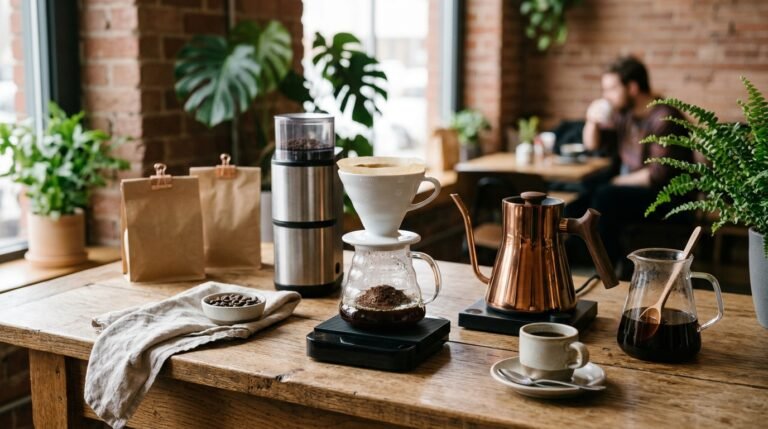
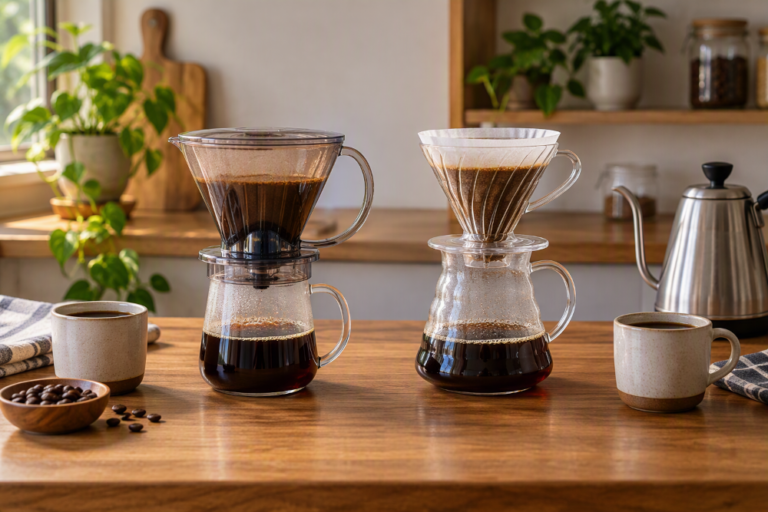
For a cleaner cup that shows off acidity and fruity notes, try a cone-shaped paper-filter dripper like the Hario V60. A gooseneck kettle, which has a thin spout, also gives you better control over how fast the water pours.
Quick tips
- At cafés, check the brew methods. V60, Aeropress and clean latte art (the design poured into steamed milk) show real focus on the coffee.
- To store beans longer, freeze the sealed bag. At -18°C (0°F), CO2 release slows by about 12.5 times. Let the bag come all the way to room temperature before opening so water doesn’t condense on the beans.
- Don’t fixate on exotic lots. A solid 84-point coffee from a good roaster beats an overpriced hyped bag.
Frequently Asked Questions (FAQ)
Is specialty coffee stronger?
Not necessarily. Strength comes from your brew ratio and method. Many specialty coffees are roasted lighter and taste sweeter and more aromatic, not harsher.
Is most coffee in the U.S. Arabica?
Yes. About 87% of the green coffee imported into the U.S. is Arabica, while worldwide production is roughly 56% Arabica and 44% Robusta.
Do I need expensive gear to start?
No. A scale, a hand burr grinder and a simple dripper make a big difference without a big bill.
So, is it worth it? If you buy fresh, grind at home and measure your coffee, absolutely.
Keep exploring